
LUNAR OBSERVATION NIGHTS
Sahara Stargazing Merzouga | Monthly Astronomy Experience

Lunar Observation Nights in the Sahara
Discover the Moon in Extraordinary Detail
On selected evenings throughout the year, Sahara Stargazing invites you to experience the Moon from the silent dunes of Merzouga. Far from city lights and surrounded by the vast Erg Chebbi landscape, the lunar surface becomes the centerpiece of an immersive astronomy experience.
Through a professional telescope, guests can explore details of the Moon that are impossible to see clearly with the naked eye—from enormous impact craters and mountain ranges to ancient lunar plains and dramatic shadows along the terminator.
A Year-Round Astronomy Experience
Unlike meteor showers or deep-sky events, a Lunar Observation Night can be enjoyed throughout the year, with different lunar phases revealing different features of the Moon.
On a Lunar Observation Night, the Moon transforms the golden dunes into a silver landscape while a telescope reveals another world thousands of kilometers away.
Location: Erg Chebbi Dunes, Merzouga
Duration: Approx. 2-3 hours
Best Time: Year-round, adapted to the Moon's phase
Style: Small Group, Professional Telescope
Highlight: The Moon's Craters & Terminator
EXPERIENCE HIGHLIGHTS:
– Professional telescope observation of the Moon
– Close-up views of lunar craters and mountains
– Guided explanation of lunar geography
– Observation of the lunar terminator
– Understanding the Moon’s phases
– Laser-guided tour of the surrounding night sky
– Arabic and Berber traditions surrounding the Moon
– Lunar photography opportunities
– Smartphone photography through the telescope
– Moroccan mint tea and traditional pastries
– Astronomy Q&A with your guide
Evening Schedule
- SUNSET - ARRIVAL AT THE DUNES
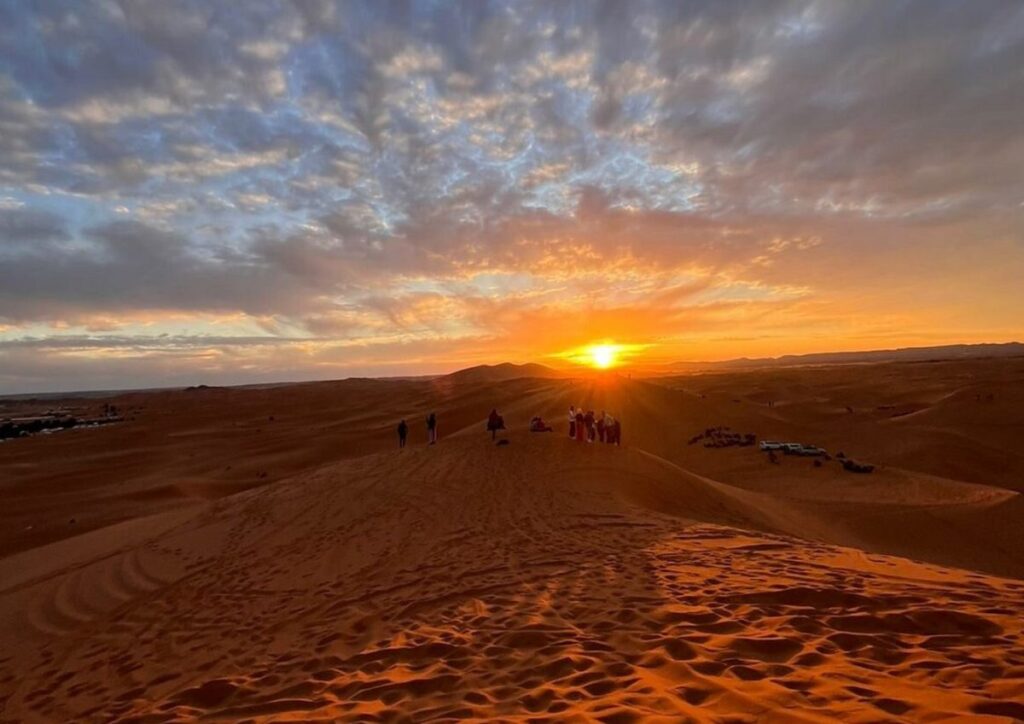
Guests arrive at the observation area as the sun begins to disappear behind the Erg Chebbi dunes. Enjoy the changing colors of the Sahara while preparing for an evening dedicated to our closest celestial neighbor.
- MOONRISE
Depending on the Moon’s position and phase, the evening begins with a spectacular moonrise over the dunes. Watch the Moon gradually emerge above the horizon while your guide explains:
– Why the Moon changes appearance
– How moonrise times change every day
– Why the Moon sometimes appears orange or golden near the horizon
– How the Moon has influenced desert cultures for centuries
- THE LUNAR TERMINATOR
Once the Moon reaches a suitable position in the sky, the main telescope observation begins. The terminator is the boundary between the illuminated and dark sides of the Moon. This is one of the best areas to observe because the low-angle sunlight creates dramatic shadows that make mountains and crater walls stand out.
- LUNAR CRATERS
Discover enormous impact craters created millions and billions of years ago. Depending on the lunar phase and observing conditions, guests may see famous formations such as:
– Tycho
– Copernicus
– Plato
– Clavius
– Aristarchus
- LUNAR MOUNTAINS & MARIA
Explore mountain ranges and elevated terrain created by ancient impacts and geological activity, then discover the lunar maria – the dark plains traditionally called the Moon’s “seas.” Learn why early astronomers believed these regions were bodies of water and what scientists now know about their volcanic origins.
- UNDERSTANDING THE MOON'S PHASES
Your guide explains the complete lunar cycle:
– New Moon
– Waxing Crescent
– First Quarter
– Waxing Gibbous
– Full Moon
– Waning Gibbous
– Last Quarter
– Waning Crescent
Guests learn why the Moon appears to change shape even though its physical shape remains the same.
- LASER-GUIDED NIGHT SKY TOUR
After exploring the Moon, your guide turns your attention toward the surrounding sky. Using a professional laser pointer, discover:
– Major constellations
– Bright stars
– Planets visible that evening
– Polaris
– Seasonal constellations
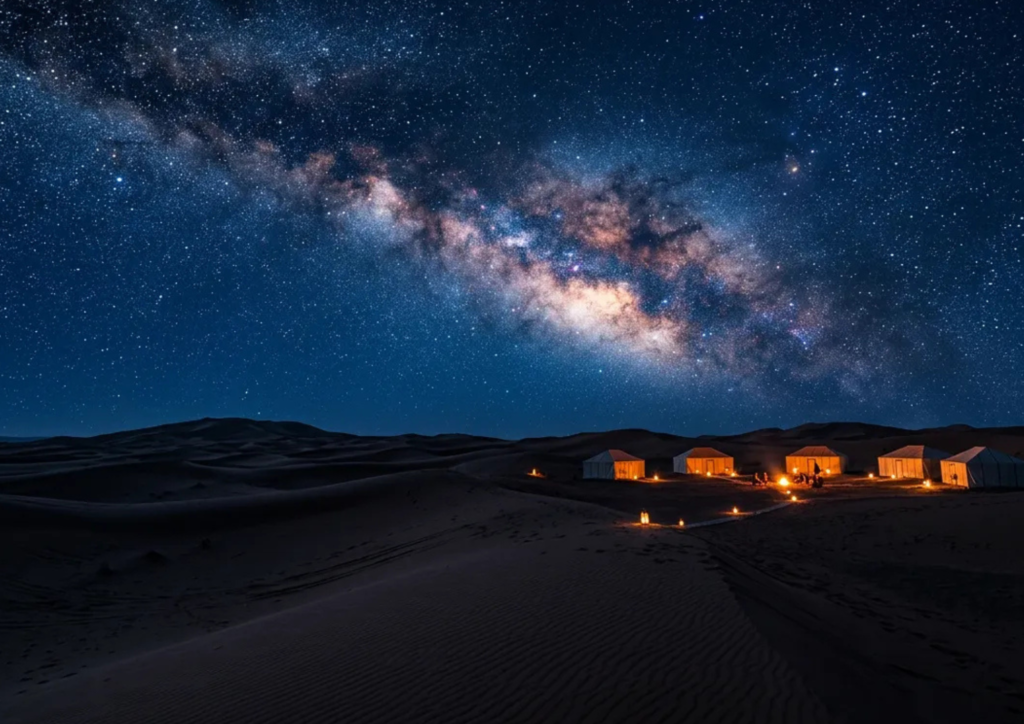
– The Milky Way when visible
You’ll also hear how Saharan nomads used the Moon and stars to understand time, seasons, direction, and travel across the desert.
- LUNAR PHOTOGRAPHY EXPERIENCE
The Moon is one of the easiest astronomical objects to photograph, making this experience ideal for beginners. Your guide can help guests capture:
– Moon close-ups
– Moon above the dunes
– Moonrise over Erg Chebbi
– Lunar landscapes
– Silhouettes of camels beneath the Moon
– Long-exposure desert landscapes
Guests can also learn how to photograph the Moon using a smartphone through the telescope.
- FULL MOON SPECIAL
Around selected full-moon dates, Sahara Stargazing can offer a special Full Moon Desert Experience. The bright Moon illuminates the dunes, creating an entirely different Sahara landscape. Instead of complete darkness, guests experience:
– Moonlit dunes
– Long desert shadows
– Night photography
– Moonrise viewing
– Lunar telescope observation
– A peaceful moonlit walk
- FIRST QUARTER MOON SPECIAL
The First Quarter Moon can provide particularly dramatic telescope views because the terminator crosses a large portion of the lunar surface. This allows guests to see:
– Strong crater shadows
– Mountain ridges
– Lunar valleys
– Different elevations across the surface
It is an excellent phase for detailed lunar observation.
- PLANET & MOON COMBINATION NIGHTS
When planets are visible alongside the Moon, the evening can be expanded into a broader astronomy session. Depending on the season and planetary positions, guests may observe:
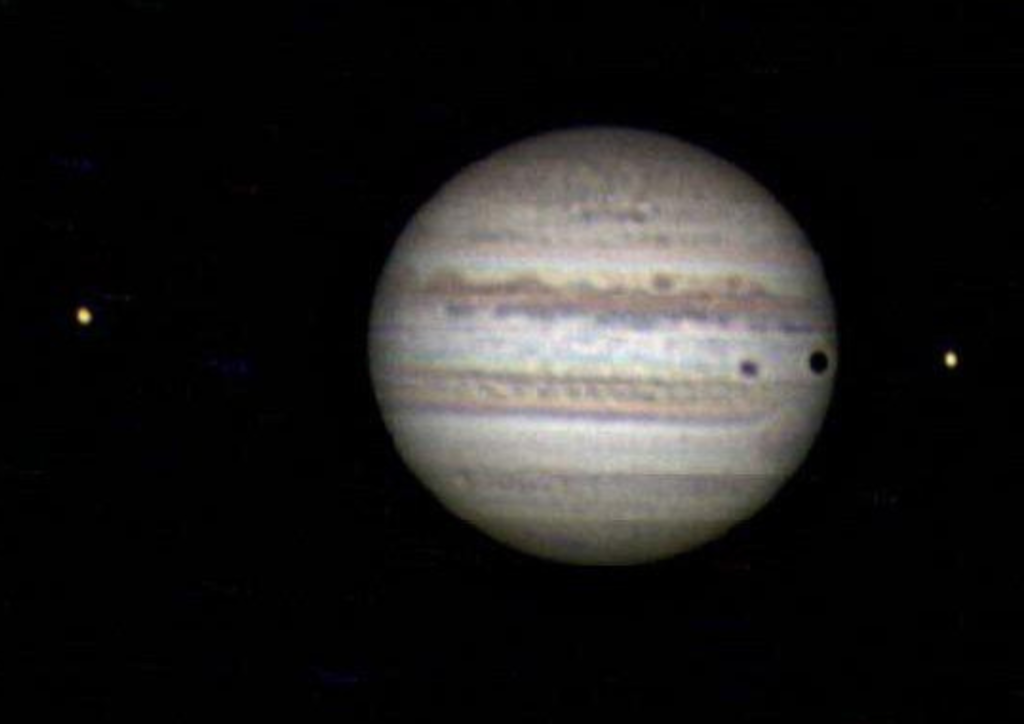
– Jupiter
– Saturn
– Mars
– Venus
– Bright stars near the Moon
The exact objects available depend on the date and observing conditions.
- SAHARA TEA & ASTRONOMY
Between observations, relax in our desert observation area with:
– Moroccan mint tea
– Traditional pastries
– Fresh dates
– Comfortable cushions
– Warm blankets during cooler evenings
Enjoy the silence of the desert while watching the Moon rise above the dunes.
- THE MOON IN SAHARAN CULTURE
The experience also explores the cultural importance of the Moon. Your guide introduces traditional Saharan and Amazigh perspectives on:
– Lunar cycles
– Desert travel
– Seasonal changes
– Traditional calendars
– Nighttime navigation
– Stories and beliefs associated with the Moon
This creates a connection between modern astronomy and the ancient relationship between desert communities and the night sky.
- WHY OBSERVE THE MOON IN MERZOUGA?
✔ Vast open desert horizon
✔ Minimal artificial light
✔ Exceptional visibility
✔ No buildings blocking the horizon
✔ Spectacular Erg Chebbi landscape
✔ Professional telescope experience
✔ Astronomy guidance for beginners and enthusiasts
✔ Authentic Sahara atmosphere
- WHAT TO BRING
– Comfortable shoes
– Camera or smartphone
– Tripod (optional)
– Warm layer during cooler nights
– Personal blanket (optional)
- SUITABLE FOR
– Couples
– Families
– Children
– Solo travelers
– Amateur astronomers
– Photography enthusiasts
– First-time telescope users
– Private groups
No previous astronomy knowledge is required.
A DIFFERENT SAHARA AFTER DARK
The Sahara doesn’t always need a completely dark sky to be extraordinary. From ancient craters formed billions of years ago to the timeless dunes of Erg Chebbi, this is an evening where the landscapes of Earth and the Moon meet beneath the same desert sky.
Best Time: Lunar Observation Nights can be organized throughout the year, adapted to the Moon’s phase and position. For detailed lunar-surface observation, the First Quarter and surrounding phases offer the strongest crater shadows. For a spectacular moonlit desert atmosphere, choose a Full Moon Night.
- Book Now & Pay Later
Please fill out the form below to contact us, and we will respond as soon as possible. For a faster response please send a WhatsApp: +212661144620 message or call us at +212661144620 . We look forward to connecting with you. Email: saharastargazing@gmail.com
- important FAQS
What is the best Moon phase for viewing craters?
The First Quarter Moon and surrounding phases offer the most dramatic crater views, since the terminator crosses a large portion of the lunar surface and creates strong shadows across craters and mountain ridges. A Full Moon is less ideal for crater detail but creates a spectacular moonlit desert atmosphere instead.
Is a telescope provided during the experience?
Yes. A professional telescope is provided and operated by your guide throughout the experience, giving you close-up views of lunar craters, mountains, and the terminator, along with help photographing the Moon through the eyepiece with a smartphone.
Is this experience suitable for children and beginners?
Yes. The Moon is one of the easiest astronomical objects to observe, making this experience ideal for children, beginners, and first-time telescope users. No previous astronomy knowledge is required.
Can Lunar Observation Nights happen year-round?
Yes. Unlike meteor showers or deep-sky events tied to a specific season, Lunar Observation Nights can be organized throughout the year, with the program adapted to the Moon’s current phase and position.
How long does the experience last?
The Lunar Observation Night lasts approximately 2-3 hours, depending on the lunar phase and observing conditions, starting at sunset and continuing through moonrise, telescope observation, and the laser-guided night sky tour.
How to pay for the experience?
Our payment process is simple and hassle-free. To confirm your booking, we require a small deposit, which can be easily paid via PayPal, bank transfer, or Wise at the time of reservation. The remaining balance is to be paid in cash on the day of the experience, in euros, US dollars, or the equivalent amount in Moroccan dirhams.
- Related Tours

5 DAY MARRAKECH MOROCCO TOUR AND STARGAZING DESERT TRIP
- Tour from marrakech
5 DAY MARRAKECH TO MERZOUGA STARGAZING DESERT TOUR
- Tour from marrakech
4 DAY TOUR TO MERZOUGA WITH STARGIZING IN SAHARA
- Tour from marrakech

4-DAY STARGIZING DESERT TOUR FROM MARRAKECH TO MERZOUGA
- Tour from marrakech