
PERSEID METEOR SHOWER NIGHT (AUGUST)
Sahara Stargazing Merzouga | Annual Astronomy Experience

Perseid Meteor Shower Night in the Sahara
Witness One of Nature’s Greatest Sky Shows
Every August, the Sahara Desert becomes one of the finest places on Earth to experience the spectacular Perseid Meteor Shower. Far from city lights and beneath one of North Africa’s darkest skies, guests can watch dozens of brilliant meteors streak across the heavens every hour.
The Perseids occur when Earth passes through a stream of dust left behind by Comet Swift–Tuttle. As these tiny particles enter our atmosphere at incredible speeds, they burn up and create the bright “shooting stars” that make this annual event famous.
With Virtually No Light Pollution
With virtually no light pollution and exceptional atmospheric clarity, the golden dunes of Erg Chebbi provide an unforgettable natural observatory for this extraordinary celestial event.
Under one of the darkest skies in North Africa, dozens of brilliant meteors streak overhead every hour, turning a single desert night into a lifelong memory.
Location: Erg Chebbi Dunes, Merzouga
Duration: Approx. 3-4 hours
Best Time: Every August, around the annual peak
Style: Small Group, Luxury Observation Area
Highlight: The Perseid Meteor Shower
EXPERIENCE HIGHLIGHTS:
– Guided Perseid Meteor Shower observation
– Professional laser-guided constellation tour
– Telescope observations of the Moon, Saturn, Jupiter, and deep-sky objects (depending on visibility)
– Introduction to the science behind meteor showers
– Berber and Arabic astronomy traditions
– Professional astrophotography opportunities
– Comfortable luxury observation area
– Moroccan mint tea and traditional pastries
– Astronomy Q&A with your guide
Evening Schedule
- 7:30 PM - WELCOME RECEPTION
Guests arrive at the observation area and are welcomed with traditional Moroccan mint tea and local pastries. Your astronomy guide introduces the evening’s program and explains why the Sahara is one of the world’s best locations for stargazing.
- SUNSET
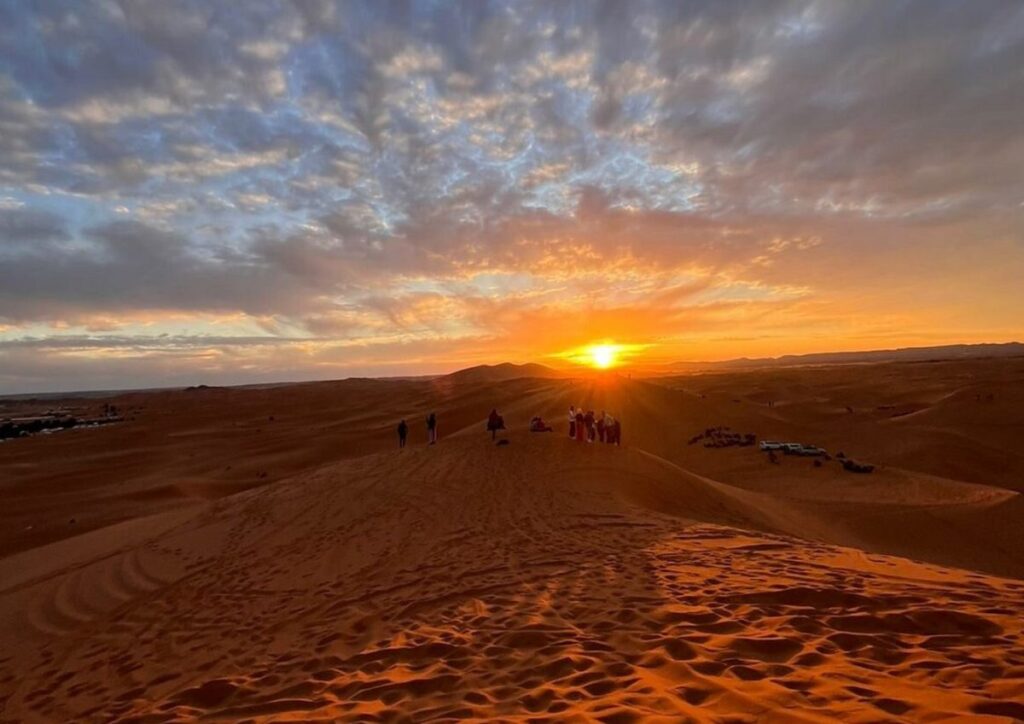
Watch the sun disappear behind the golden dunes while enjoying panoramic desert views. This is the perfect time for photography before darkness falls.
- TWILIGHT
As the sky gradually darkens, your guide explains:
– Why the Sahara has exceptionally dark skies
– What causes meteor showers
– The story of Comet Swift–Tuttle
– How astronomers predict meteor showers
– Best viewing techniques
- STARGAZING SESSION
Using a professional laser pointer, your guide identifies:
– Polaris (North Star)
– Summer Triangle
– Cassiopeia
– Cygnus
– Lyra
– Aquila
– Scorpius
– Sagittarius
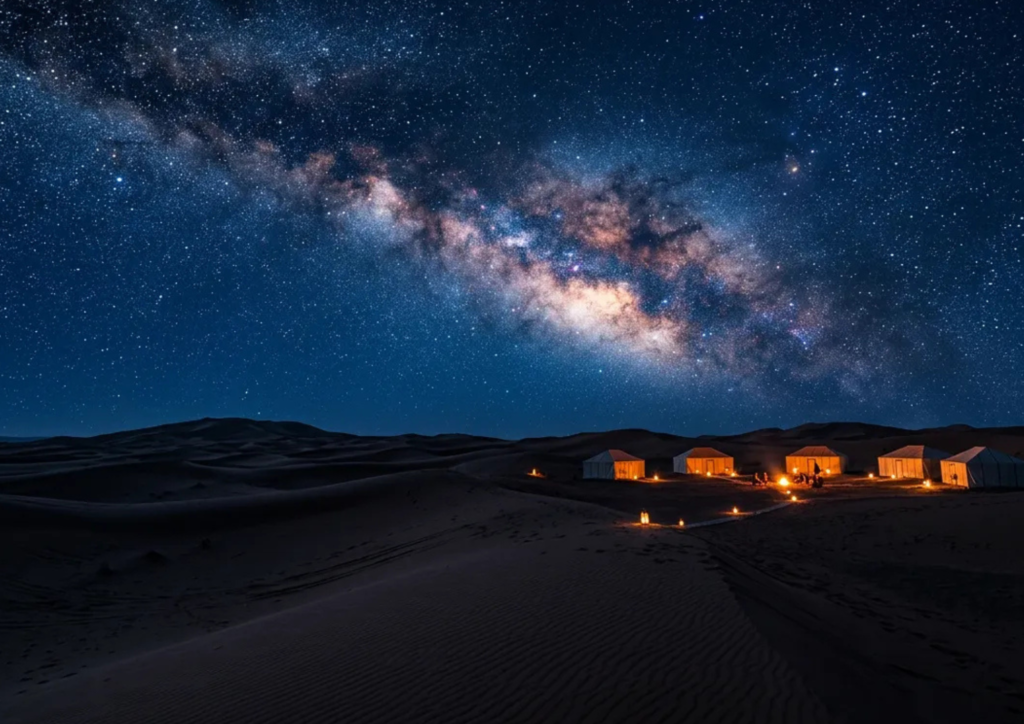
– Milky Way
You’ll also discover the Arabic and Berber names of many stars and hear how desert nomads used them for navigation across the Sahara.
- PEAK METEOR OBSERVATION
Now the lights are turned off completely. Guests relax on reclining chairs, comfortable cushions, or traditional Berber carpets while watching meteors cross the sky. No telescopes are needed to observe the Perseids—the naked eye offers the best experience. Each meteor leaves a bright trail across the sky, with some producing spectacular fireballs. Your guide helps identify particularly bright meteors and explains what is happening in real time.
- TELESCOPE OBSERVATION
Between meteor activity, guests can observe celestial objects through professional telescopes (weather and sky conditions permitting), such as:
– The Moon
– Saturn’s rings
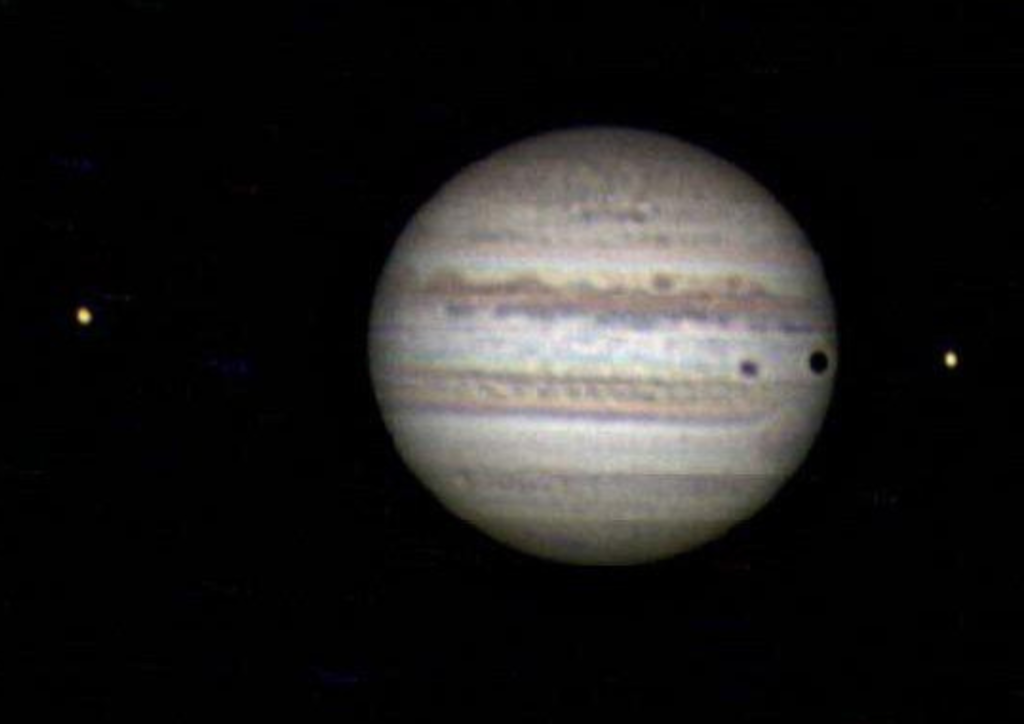
– Jupiter and its moons
– Star clusters
– Nebulae
– Double stars
- ASTROPHOTOGRAPHY
Guests may photograph:
– The Milky Way
– Meteor trails
– Night landscapes
– Camel silhouettes
– Luxury camp under the stars
– Portraits beneath the Milky Way
Professional photography services may also be available.
- BERBER TEA BREAK
Relax beside a traditional lantern-lit seating area while enjoying:
– Moroccan mint tea
– Fresh dates
– Local pastries
– Seasonal snacks
- ASTRONOMY QUESTIONS & DISCUSSION
Before the evening concludes, guests are invited to ask questions about:
– Meteors
– Planets
– Galaxies
– Black holes
– Space exploration
– The night sky over the Sahara
- WHAT MAKES THE PERSEIDS SPECIAL?
– Active every year in August
– One of the brightest meteor showers of the year
– Frequently produces bright fireballs
– Best viewed after midnight
– Visible without binoculars or telescopes
– Ideal for photographers
- WHY EXPERIENCE IT IN MERZOUGA?
✔ One of North Africa’s darkest skies
✔ Almost no light pollution
✔ Exceptional visibility
✔ Stable desert atmosphere
✔ Stunning Erg Chebbi dunes
✔ Luxury desert camp setting
✔ Professional astronomy guidance
✔ Authentic Berber hospitality
- WHAT TO BRING
– Warm jacket (desert nights can be cool)
– Comfortable walking shoes
– Camera or smartphone
– Tripod (recommended)
– Red-light flashlight (optional)
– Personal blanket (optional)
- SUITABLE FOR
– Couples
– Families
– Solo travelers
– Photography enthusiasts
– Amateur astronomers
– Nature lovers
– Private groups
No previous astronomy experience is required.
AN UNFORGETTABLE NIGHT BENEATH THE SAHARA SKY
Watching the Perseid Meteor Shower from the silent dunes of Merzouga is more than an astronomy event—it’s an unforgettable encounter with the universe. Under one of the clearest skies in the world, surrounded by the timeless beauty of the Sahara, every shooting star becomes a memory you’ll carry long after your journey ends.
Best Time: Every August, with the highest meteor activity typically occurring around the annual peak. Exact viewing conditions vary each year according to the meteor shower peak, weather, moonlight, and local sky conditions.
- Book Now & Pay Later
Please fill out the form below to contact us, and we will respond as soon as possible. For a faster response please send a WhatsApp: +212661144620 message or call us at +212661144620 . We look forward to connecting with you. Email: saharastargazing@gmail.com
- important FAQS
When is the best time to see the Perseid Meteor Shower in Merzouga?
The Perseids are active every August, with the highest meteor activity typically occurring around the annual peak. Exact viewing conditions vary each year according to the meteor shower peak, weather, moonlight, and local sky conditions. Meteors are generally best viewed after midnight.
Do I need a telescope to see the meteors?
No telescope is needed. The Perseids are best observed with the naked eye against the Sahara’s exceptionally dark skies. Telescopes are available between meteor activity for observing the Moon, Saturn, Jupiter, and other deep-sky objects, weather and visibility permitting.
What should I wear or bring for the night?
Bring a warm jacket, as desert nights can be cool, along with comfortable walking shoes, a camera or smartphone, a tripod if you plan to photograph, and an optional red-light flashlight and personal blanket for extra comfort.
Is this experience suitable for children and beginners?
Yes. The experience is suitable for couples, families, solo travelers, photography enthusiasts, amateur astronomers, and private groups alike. No previous astronomy experience is required — your guide explains everything in an accessible, engaging way.
How long does the experience last?
The Perseid Meteor Shower Night lasts approximately 3–4 hours, depending on meteor activity and weather conditions, starting with a 7:30 PM welcome reception and continuing through sunset, twilight, peak meteor observation, and telescope viewing.
How to pay for the experience?
Our payment process is simple and hassle-free. To confirm your booking, we require a small deposit, which can be easily paid via PayPal, bank transfer, or Wise at the time of reservation. The remaining balance is to be paid in cash on the day of the experience, in euros, US dollars, or the equivalent amount in Moroccan dirhams.
- Related Tours

5 DAY MARRAKECH MOROCCO TOUR AND STARGAZING DESERT TRIP
- Tour from marrakech
5 DAY MARRAKECH TO MERZOUGA STARGAZING DESERT TOUR
- Tour from marrakech
4 DAY TOUR TO MERZOUGA WITH STARGIZING IN SAHARA
- Tour from marrakech

4-DAY STARGIZING DESERT TOUR FROM MARRAKECH TO MERZOUGA
- Tour from marrakech